Upright or Spreading Plants for a Narrow Border?
Upright or spreading plants for a narrow border? Compare their shapes and choose a planting pattern that adds height without crowding the space.
Should you choose upright or spreading plants for a narrow border? The answer depends on what the border needs to do: screen a view, soften a hard edge, or make a slim strip feel composed rather than crowded. Upright plants use height with a relatively small footprint; spreading plants occupy more ground and can bridge gaps. Choose by the job, then check how each plant’s mature shape fits the available space.
Start with the border’s main job
Stand where you usually see the border, not only beside it. A narrow strip along a fence may need height to soften a blank plane, while a border beside a path may need its edges kept clear. Those situations call for different forms even if the soil and light are similar.
Look at the border from the house, a gate, or a seating area. Note what draws the eye and what you want plants to conceal, frame, or leave visible. A tall, narrow silhouette can interrupt a long horizontal fence. A low, spreading plant can make the ground beneath a small tree or shrub feel settled without adding another vertical accent.
Decide which one of these needs matters most:
- Height without much width: Favor upright plants that keep their main body narrow.
- Coverage along the ground: Favor spreading plants that can knit together open soil or soften a border edge.
- A mixed effect: Use both forms, but give each a distinct role so the narrow bed does not become a wall of stems above a solid mat of foliage.
If the border is too slim to fit both roles comfortably, choose the more important one. Trying to create a full layered planting in every narrow strip can leave little room for access or for the plants to develop naturally.
Choose upright plants when the border needs height
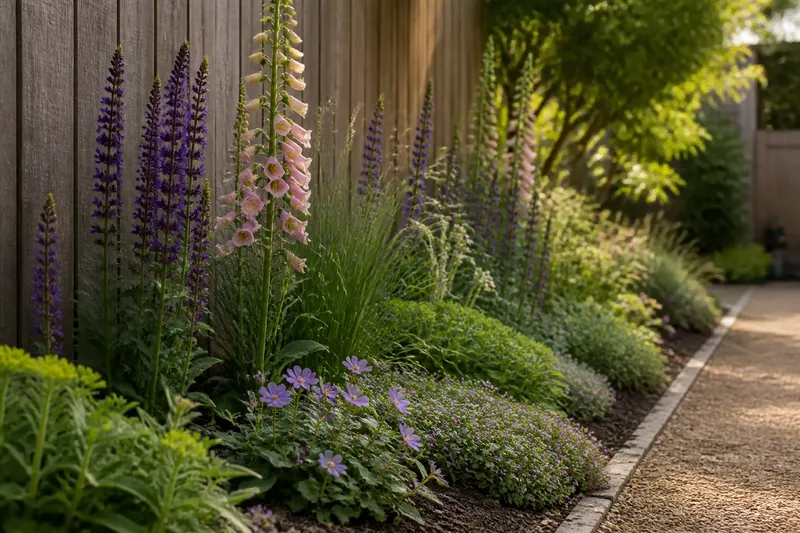
Upright forms suit narrow borders where a vertical accent matters more than broad ground cover. Look for plants with a naturally columnar or clump-forming habit, such as foxglove, salvia, or an upright ornamental grass. Their stems can lift color or texture above lower planting while keeping the composition visually lean.
“Upright” does not mean every stem must stand like a pole. A plant may rise from a compact base and still carry outward-facing leaves or flowers. Check the whole silhouette, including its foliage, rather than judging only by the flower spike in a nursery pot. A plant that appears slim when young may become a broad clump as it matures.
Upright planting is a useful fit when:
- A fence, wall, or hedge needs a softer foreground without another wide shrub.
- The border sits beside a path and the planting should stay visually close to the bed.
- A gap needs a clear focal accent, such as a vertical flower spike among lower foliage.
- You want to preserve views through or beyond the border rather than create a continuous screen.
For a narrow bed, use upright forms as accents rather than lining every inch with tall stems. Repeated vertical shapes can make a border feel rigid, and dense upright foliage may still shade neighboring plants. A few well-placed forms, with lower companions around their bases, usually create more readable height.
Choose spreading plants when the ground needs a softer edge
Spreading plants are useful where the border looks bare at ground level or where a hard edge needs softening. They may creep, trail, or broaden into a low mound. Creeping thyme, hardy geraniums, and some sedums offer different textures and flowering habits, but each should be chosen for its particular growing conditions and eventual spread.
A spreading plant can make a narrow border look wider by drawing foliage toward the edge. That can be appealing beside a lawn or open paving, but it can also narrow a path if the growth leans into the walking space. Treat the border’s boundary as a real limit, not as a line the plant will automatically respect.
Spreading forms fit well when:
- The soil is exposed and you want foliage to link separate plants visually.
- The border edge looks abrupt beside lawn, gravel, or paving.
- There is room for low growth to extend without obstructing access.
- The planting needs a lower counterweight beneath taller flowers or grasses.
Check whether a plant spreads by short runners, rooting stems, or gradual widening. These habits are not interchangeable. A plant that forms a steady mound is easier to place in a tight composition than one that keeps advancing into neighboring space, especially if nearby plants are slow-growing.
Match the form to the border’s width and viewing angle
A narrow border is not just a small planting area; it is a planting area with limited room for depth. If viewed from one side, taller plants usually read clearly toward the back, with lower or spreading forms nearer the edge. Where the border is visible from both sides, a single “back” may not exist. In that case, place the tallest plants nearer the middle and keep the edges low enough to preserve a balanced outline.
Imagine a slim bed beside a sunny path, with a plain fence behind it and room for one compact clump near the back. You want the fence softened, but you also want the path unobstructed. A narrow upright salvia could supply the vertical accent, while a low, restrained spreader fills some ground near the edge; leaving open soil around the clump keeps the arrangement from becoming a solid strip. The expected result is a clear point of height and a gentler border line, without asking the low plant to do the screening.
Light, moisture, and soil can change which candidates make sense. A plant that fits the shape but struggles in the site will not provide the form you planned for. Compare the growing conditions on the plant label or from the grower with the conditions in the border; where instructions or local rules apply, follow them.
Combine upright and spreading forms without crowding
When both forms suit the site, assign them different tasks. Let upright plants provide the main height, and use a restrained spreading plant to soften a selected edge or connect a small group. Avoid pairing several vigorous spreaders simply because they look tidy in containers. Their combined growth can quickly obscure the differences in shape that made the planting attractive.
A useful way to sketch the arrangement is to mark each plant’s mature outline on paper. Draw the border as a narrow band, then place circles or narrow ovals for the expected plant shapes. Leave visible gaps rather than filling every space on the drawing. Those gaps allow individual forms to remain legible and give you room to reach in for ordinary care.
Choose plants with compatible needs as well as compatible outlines. A moisture-loving spreader may not be a good neighbor for an upright plant that prefers drier soil. If their requirements differ, grouping them in the same narrow strip can make care awkward. Repeating one suitable low plant near several upright accents often looks more coherent than adding unrelated spreaders throughout.
It is not worth forcing a strict height ladder into a border that is only viewed from one angle or that has little room to spare. Nor do you need to trim every plant into a geometric shape to make it orderly. Choosing forms that naturally suit the space usually asks less of both the planting and the gardener.
How do you decide between upright and spreading plants?
Which form works best beside a narrow path?
Upright plants are often the easier choice if the path must stay clear, because their main growth can remain close to the bed. Choose a naturally compact form and allow for its full width rather than relying on frequent cutting to hold it back.
Can spreading plants make a border look wider?
They can soften an edge and draw the eye outward, making the planting feel less like a thin line. Keep the growth in scale with the path, lawn, or paving beside it so that the effect remains welcoming rather than obstructive.
Should tall plants go at the back?
Usually, if the border is viewed mainly from one side, placing taller forms toward the back helps preserve sightlines to lower plants. In a bed viewed from several directions, a central placement for the tallest forms may feel more balanced.
How do you keep the two forms from competing?
Give each one a distinct role and avoid choosing plants that reach similar heights and widths. A few upright accents above a limited area of low growth create clearer contrast than filling the whole bed with tall stems and spreading foliage.
Make the choice from mature shape, not the nursery pot
At the garden center, look for the plant’s stated spread and habit, then picture that outline in the border. A tall pot can disguise a plant that becomes broad; a small pot can contain a plant that eventually runs well beyond its original spot. If the label does not make the mature shape clear, ask the grower before committing.
For a narrow border, upright or spreading plants are not competing styles so much as different tools. Upright forms are the better fit when height and a small footprint are the priority. Spreading forms suit open ground and soft edges, provided there is room for their growth. A considered mix can work too, but the space should decide how much of each it can carry.
Before buying, look once more from the place where you most often see the border. If you want a lifted focal point, choose an upright silhouette; if you want the ground to read as a softer, connected edge, choose a spreading one. That final view is a practical way to keep plant form, border width, and the garden’s character in balance.